If you watch cricket regularly, you’ve probably noticed that after the first innings ends, there is a break in the innings, and play doesn’t resume immediately. Instead, there is a scheduled innings break time before the next one begins. Many fans often search online for innings break time in ODI, especially during live matches. They do that because they are either eager to watch the second innings or have to do some urgent work before the play starts.
This article will cover ODI innings break time and how it compares to T20 cricket and Test cricket.
Let’s get started!
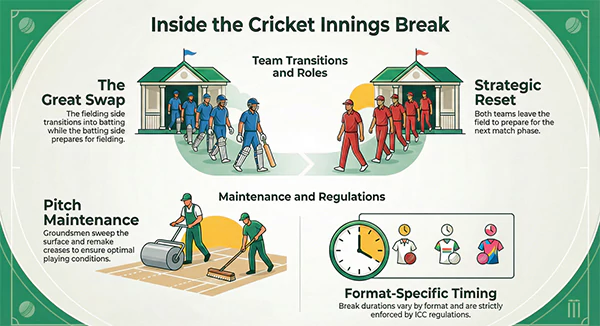
In cricket, an innings break is the duration between the end of one team’s batting and the start of the second team’s batting. This is a critical period when both teams leave the field and prepare for the next innings. During this period, the fielding side transitions into batting roles, and the batting side prepares for fielding.
During the innings break time, groundsmen also perform light pitch maintenance, such as sweeping or remaking creases. It ensures the optimal playing conditions for the next part of the match.
The duration of the innings break varies significantly by format. All formats have different rules and regulations, enforced by ICC, related to innings breaks. We will explore those in the next sections.
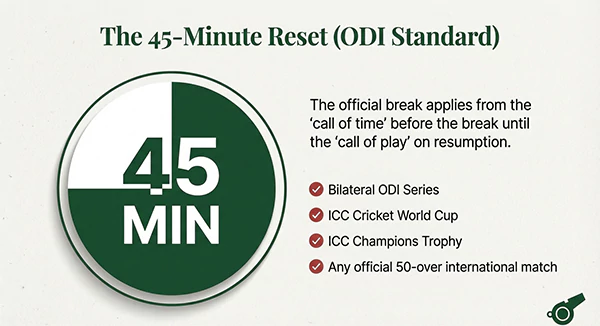
The official innings break time in ODI cricket is 45 minutes. This is taken from the call of time before the break until the call of play on resumption after the break. Check out the guide from ICC-Cricket on an ODI Match.
This rule applies to bilateral ODI series, the ICC Cricket World Cup, the ICC Champions Trophy, and any official 50-over international match.
The umpires have the authority to reduce the duration of the innings break time in ODIs in case there is a loss of time in the first innings. This is done so that the match gets completed on time. If up to 15 minutes of playing time is lost, then the break will be reduced by the amount of actual playing time lost.
If more than 15 minutes are lost during the first innings, then the break will be reduced to 30 minutes. This can also vary and depend on the match situation as decided by the umpires and the match referee.
The ODI innings break time is very important for players to rest, change gears, and more. During this period, coaches plan bowling strategies and officials analyze pitch conditions.
If you are watching the match on TV, you will see mid game analysis show and highlights. This interval in ODI games is essential, as matches are long, close to 7-8 hours.
If you are not sure or broadcasters are not displaying the actual remaining innings break time in ODI games, then you can calculate it by yourself.
The 2nd innings start time can be calculated via this formula.
Second innings start = First innings end time + 45 minutes
For example, if the first innings ends at 5:25 PM, then the chase in the second innings will start by 6:00 PM. Unexpected delays like rain or injuries can change this slightly. Most of the time, the play starts at the designated time.
If you are looking for an innings break time in the Champions Trophy or World Cup, then the answer is the same. In all ODI events, ICC keeps this time fixed to maintain broadcasters’ schedules. It also ensures that the teams get equal time to prepare.
The innings break time in T20 cricket is shorter than in ODI cricket.
The T20 innings break time is 20 minutes.
A typical T20 match lasts around 3 hours. One innings of a T20 game is expected to be completed in 1 hour and 25 minutes. Because of this, the break time in T20 cricket is shorter. In shorter games, players require less time to recover, and the broadcast schedule is also tight. That is precisely why T20 chases begin quickly after the completion of the first innings. You can check out the ICC break time rules for T20 cricket.
Due to the shorter break time, you might have seen some batsmen rushing back quickly to the dressing room right after the completion of the first innings.
Test cricket works differently because it lasts for five days. Innings break time in test cricket is different because it has more than two innings.
The break time in test cricket changes depending on the time and the match situation. You can check out the ICC rules on break time in Test cricket. Here is the short version of these rules.
So, the innings break time in Test cricket is not a long fixed interval like ODIs.
Here is a quick comparison table of innings break time in various formats of cricket. Have a look.
| Format | Innings Break Time |
| ODI (50 overs) | 45 minutes |
| T20 | 20 minutes |
| Test Match | 10 minutes (innings change) |
| Champions Trophy ODI | 45 minutes |
Innings breaks are more than just about giving rest to players. They have other purposes too. Have a look.
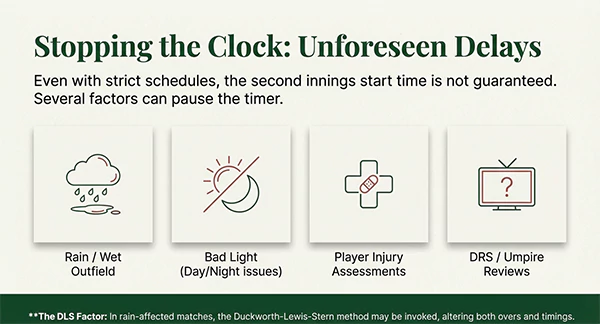
There is a possibility that the second innings will not start exactly on time. A couple of factors are responsible for that. Here is the list.
The DLS method can also be used in rain-affected matches. It can also change the overs and restart timings.
Related Read: Cricket Fielding Positions
The innings break time in ODI cricket is officially 45 minutes. It is enough time for both teams to prepare for the chase and adjust strategies. When comparing it with T20’s quick interval and Test cricket’s session-based breaks, the ODI innings break time is designed to balance player recovery, tactics, and broadcasting requirements.
If you want to know when the second innings will begin, just add 45 minutes to the finishing time of the first innings.
Ans: The ODI innings break lasts 45 minutes.
Ans: The T20 interval is usually about 20 minutes.
Ans: It starts 45 minutes after the first innings ends.
Ans: Yes, ICC tournaments also follow the 45-minute break rule.
Ans: Test match innings changes take around 10 minutes, with separate lunch and tea breaks.
Sources: