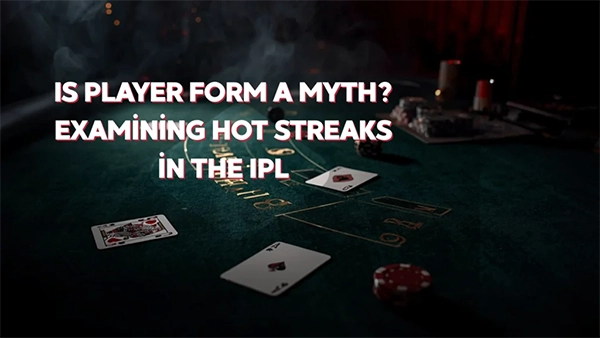
Commentators love the narrative. A batsman hits his third boundary in an over and suddenly he is described as being in the form of his life, playing with rare fluency, untouchable. Fans feel it too: something in the crowd shifts when a player appears locked in, and the assumption spreads that whatever he touches will turn to gold. This concept of player form, a temporary window of peak performance, sits at the heart of how cricket is analysed and discussed. But what if it is largely an illusion? What if the hot streak is simply a story we construct to impose order on random variation?
The question deserves a serious statistical answer, because the implications for how we evaluate, select, and bet on IPL players are significant.
The belief in form is closely tied to a well-documented cognitive bias known as the hot hand fallacy. The original research by Gilovich, Tversky, and Vallone examined basketball players and found that a player’s probability of making a shot was statistically independent of whether they had made the previous one. A streak of successful shots was no more likely to continue than a streak of misses was to end. The same statistical independence has been identified across a range of competitive disciplines. The team at Blackjack Insight demonstrates how human pattern recognition consistently overestimates the predictive power of recent outcomes, whether at a card table or on a cricket pitch.
Understanding this bias is the first step toward more honest analysis. It does not mean streaks do not exist; it means that their existence in the past tells us less about future performance than we instinctively believe.
Cricket, particularly in the T20 format, contains an unusually high level of inherent randomness. Each delivery involves a dense intersection of variables: the bowler’s release point, seam position, pitch behavior, the field setting, the batsman’s reading of length, and the split-second biomechanical execution of the shot. Skill dominates over the long run, but within any individual innings, variance plays a substantial role.
A perfectly timed drive can go straight to a fielder placed precisely there. A mistimed heave over midwicket can clear the rope for six. Neither outcome reliably signals a change in the batsman’s underlying ability. What looks like a player finding his touch, or losing it, may simply be the natural clustering of positive and negative outcomes that any random sequence will produce over a short window of data. The human brain is extraordinarily good at perceiving patterns; it is considerably less reliable at distinguishing genuine signal from statistical noise.
When analysts examine T20 data rigorously, the results consistently challenge the conventional narrative around form. The format’s compressed structure amplifies variance: a player can score an unbeaten eighty in one fixture and fall for a golden duck in the next without any meaningful change in their skill level or preparation. The volatility is built into the game.
A core statistical principle relevant here is regression to the mean. Following an unusually high or low performance, a player’s next result is more likely to sit closer to their long-term average than to replicate the outlier. The batsman who scores a century is, statistically, more likely to produce a modest return in the following match than another century. This principle extends across competitive domains where probability governs outcomes, as explored in analyses of how blackjack strategy principles apply to business decision-making under uncertainty. In both contexts, long-term averages consistently outperform recent streaks as predictors of future performance.
This does not mean short-term data is worthless. Pitch conditions, opposition matchups, and workload all matter. But the weight given to a player’s last three innings, in isolation, is almost certainly higher than the evidence justifies.
None of this means form should be dismissed entirely. The statistical case against the hot hand concerns observable outcomes, but the psychological dimension of form operates through a different mechanism and produces real effects. A player who believes he is in form plays with greater freedom. He commits to his shots, trusts his instincts under pressure, and is less likely to fall into the hesitancy that disrupts technique. This confidence is not imaginary; its behavioral consequences are measurable.
Equally, a player who feels he is out of form may tighten his grip, second-guess his decisions, and alter his natural game in ways that genuinely reduce his effectiveness. The narrative of form, even when statistically unfounded, can become self-fulfilling through the psychology of performance. What we observe as a hot streak may not be a mystical force acting on the ball, but it may well reflect a genuine shift in a player’s mental state and, through that, in the quality of his execution.
Ans: Skill is the stable, long-term foundation of a player’s ability, reflected in career averages across large sample sizes. Form is the perceived short-term deviation from that baseline. Skill is a reliable predictor of future performance; form, in most cases, is statistical variation dressed up as a meaningful trend.
Ans: Confirmation bias plays a central role. The mind notices and remembers the dramatic sequence of boundaries or wickets, while the unremarkable deliveries in between fade from attention. This selective memory creates the impression that streaks are both more frequent and more sustained than the data actually supports.
Ans: Yes. Teams that weight long-term averages and contextual matchup data over recent form narratives make more reliable selection decisions. Persisting with a high-skill player through a statistical slump, rather than replacing them with a lower-skill player on a temporary upswing, is generally the more defensible strategy.
Ans: It applies equally. A bowler who takes three wickets in a spell may be described as unplayable, but the probability of a wicket on the next delivery remains primarily a function of their career strike rate and the specific match context, not the outcome of the previous ball.